

The CMHA report has a line in it that surprised us at first.
60.5% of rural Canadian men say they are never or rarely lonely. Urban men: 51.9%. On paper, country guys report being more connected than city guys.
Then we read the rest of the data.
Belonging Looks Different in Small Towns
The same Closing the Distance report shows 62.2% of rural and remote Canadians report a strong sense of belonging to their local community. Urban: 52.3%.
That matches what we know from our own kitchens. In a small community, you see the same people at the grocery store, the rink, the church, the bar, the auto shop, the funeral home. There is built-in repetition. That is real connection.
The 2024 data also show that 56.9% of rural residents rarely or never feel lonely, compared to 48.6% in cities. But here is the part that gets less attention.
12% of rural Canadians say they feel lonely often or always. Urban rate: 13.6%. The “often or always” gap is small. The middle of the curve is what shifts.
The Men Who Won’t Say They Are Lonely
Loneliness research has a known limitation. It depends on self-report. Men are systematically less likely than women to identify loneliness when surveyed, especially in cultures where loneliness reads as weakness.
The CMHA data show it. In rural and remote areas, 14.3% of women say they are often or always lonely. For men, that number is 9.7%. A real difference. Maybe.
Or maybe it is what men will admit on a survey. The same men who tell their wives “I’m fine” are not going to tick “always” on a Statistics Canada questionnaire.
We are not calling the data wrong. We are saying the data are doing exactly what they were designed to measure, and the thing they were designed to measure is partly the willingness to name what is happening.
Why This Matters for How We Help
A man in a rural community might have 30 people who know his name, his truck, his job, and his kids’ birthdays. He might still have nobody he would call at 11pm on a Tuesday in February.
Familiarity is not the same as intimacy. Visibility is not the same as being known. A wave at the gas station is real connection. It is also not enough.
The brothers we have lost in the MenTELL network mostly lived in places where they were known. They had crews. They had families. They had church groups, hockey teams, fishing buddies.
Belonging was there. The specific brother who would have asked the specific question was missing.
What We Are Building for June
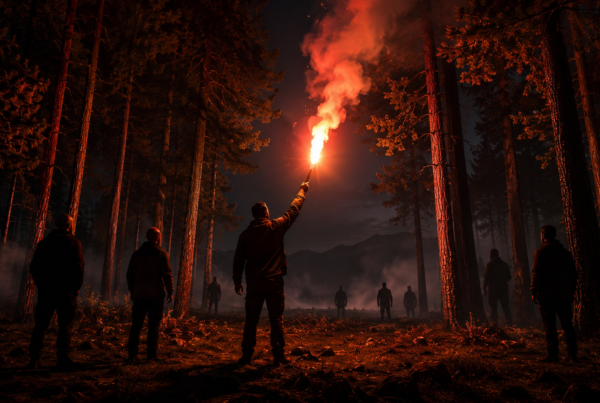
Be the Flare is built for that specific man in that specific town. Not a clinical intervention. Not a wellness program. Just one signal from a brother who has been there.
For Men’s Mental Health Month Canada this June we are asking one million Canadians for one video. One line. Two names. 48 hours. The mechanic is small on purpose. The reach is what we are after.
The math is simple. Each man tags two others. Those two tag two more. If the chain holds, a single video is two men deep at the start and two thousand men deep in ten rounds.
What You Can Do Tonight
Pick a buddy. Send him a text right now. Not “how are you,” he will say “good.” Try this instead. Hey, I read something today that made me think of you. Want to grab a coffee this week.
If you are reading this and you are the one who would not pick up if your buddy called, follow @MenTELL.ca on Instagram and find a brother in the year-round community at mentell.ca.
Sources
- Canadian Mental Health Association. (2026). Closing the Distance.
- Statistics Canada Canadian Social Survey, 2024.