

If you grew up in Canada, you probably learned about PTSD from a movie. Or a news clip about a veteran. Maybe a friend who came home different. We learned about it the same way most men do. We did not learn about it from a doctor. June is PTSD Awareness Month in Canada, and June 27 is National PTSD Awareness Day per Statistics Canada. It overlaps directly with Men’s Mental Health Month, which is not a coincidence. The men most likely to live with post-traumatic stress in this country are the men least likely to talk about it.
Who is most affected
The list reads like a roll call of jobs we expect men to do without flinching.
Veterans
Veterans Affairs Canada has documented elevated rates of post-traumatic stress and operational stress injuries among Canadian veterans. The Atlas Institute for Veterans and Families has been a steady source for us when we want plain-language facts about Canadian veterans, and the VAC Assistance Service at 1-800-268-7708 is free, confidential, and 24/7 for veterans, their families, and caregivers.
First responders, police, paramedics, firefighters, correctional officers
Canadian research through CIPSRT (the Canadian Institute for Public Safety Research and Treatment) has documented post-traumatic stress injury (PTSI) prevalence among first responders that runs several times higher than the general population. Boots on the Ground offers confidential 24/7 peer support for Canadian first responders, by current and former first responders.
Survivors of accidents, violence, and medical trauma
This is the part of PTSD Awareness Month that gets the least airtime, and it should not. Trauma does not need a uniform. Per the Canadian Mental Health Association, anyone who has been through a serious accident, an assault, a workplace incident, or a hard medical event can develop PTSD.
Indigenous communities
The Hope for Wellness Helpline at 1-855-242-3310 offers culturally safe support, 24/7. We send men there for a reason. Trauma in Indigenous communities is not a footnote, it is the headline.
What we keep hearing from Canadian men
The same three things, over and over.
“I thought I was fine for years”
The slow burn version of PTSD does not look like a movie. It looks like a guy who is short-tempered for no reason, sleeps badly, drinks more than he used to, and snaps at the wrong people. He is not faking. He is also not lazy. He is carrying something he does not have words for yet.
“I did not want to lose my job”
This is the one that hurts. Police officers, firefighters, paramedics, and trades workers told us they sat on symptoms for years because they were afraid disclosure would end their career. The CIPSRT work in Canada is changing that, but slowly.
“I did not want to scare my kids”
So they hid it. So the kids learned to hide it too. So the next generation of men inherits the same playbook. We wrote about that pattern in Why Men Mask Mental Health.
Signs we tell men to watch for
From the CMHA primer:
- Re-experiencing the event through flashbacks, intrusive memories, or nightmares.
- Avoiding people, places, or situations that bring it back.
- Persistent anger, low mood, numbness, or loss of interest in things that used to matter.
- On-edge, jumpy, sleep disturbance, irritability.
If you have been carrying any of those for more than a month after a hard event, that is a clinical reason to talk to a doctor. Not a personal failure.
What MenTELL is doing in June 2026
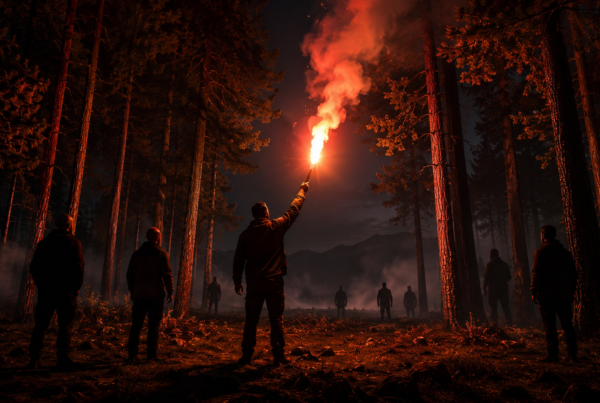
MenTELL is the movement behind mensmentalhealthmonth.ca and mensmentalhealthweek.ca. PTSD Awareness Month sits inside our four anchor moments: all of June, Men’s Mental Health Week (June 9 to 15), Men’s Mental Health Awareness Day (June 13), and National PTSD Awareness Day on June 27. Our 2026 #BeTheFlare peer-to-peer campaign runs all month. One sentence, two names said out loud, 48 hours to keep the flare alive. If you have lived with PTSD or known someone who has, you are exactly the man we want on camera.
If you need help right now
- 988 Talk Suicide Canada, call or text 988, free 24/7.
- VAC Assistance Service, 1-800-268-7708, free 24/7 for veterans and their families.
- Boots on the Ground, confidential 24/7 peer support for Canadian first responders.
- Hope for Wellness Helpline (Indigenous), 1-855-242-3310.
- ca/” target=”_blank” rel=”noopener”>, free counselling.
Sources: CIPSRT, Atlas Institute for Veterans and Families, Statistics Canada, CMHA, Veterans Affairs Canada.